Case Study: How Grind 24-7 Uses Uplift Capture for Rapid Pitching Development
Author:
Ricky Pimentel
|
February 27, 2026
Grind 24-7 runs a high-intent throwing environment. But like most academies, they still faced the challenge of proving what changed, pinpointing what to fix next, and keeping the arm healthy while chasing velocity.
This case study shows how Grind 24-7 used Uplift Capture to run a simple before-and-after process for two pitchers in their SAVAGE Throwing Performance Program. Over a 9-week window (Oct 2025 → Dec 2025), both athletes improved in ways coaches look for: throwing harder, getting the ball out faster, cleaning up common mechanical leaks, and building a clearer plan for what to work on next.
The Real Coaching Problem: Turning Film into Decisions
Coaches can spot issues with the naked eye, but the challenge is consistency and certainty. When a player is stuck, you’re deciding between a dozen possible “fixes.” Uplift Capture is built for that gap, giving coaches a clear before-and-after view to make decisions on:
What changed (to prove the program is working)
What still leaks (to set the next coaching target)
What looks risky (to protect the arm while developing velo)
How Grind 24-7 Used Uplift
This is the exact, easy process any academy can run:
Initial Assessment and Program Training: The first 2 weeks of training immediately follow the initial player evaluation and incorporate SAVAGE techniques.
Progress Assessment: After another 4 weeks of training, a progress test is conducted.
Movement Refinement: The final 3 weeks of the program are dedicated to refining movements learned.
Final Review and Test: The program concludes with a final review and test.
Daily Player Tracking and High-Tech Facility
Grind 24-7 uses 2D video analysis daily to track each player's development, so they can monitor their progress as they refine the pitching movement. Their facility is equipped with 6 iPads, high-level Wi-Fi capability, and monitors spaced throughout to allow players to easily view their progress.
Athlete 1: Gio Studeny (LHP)
Gio came into the program with good ingredients, but like many developing pitchers, he had a few common leaks that limited how well he could transfer energy up the chain. The goal was not to reinvent his delivery. The goal was to get him moving faster and cleaner, then keep one clear improvement target for the next phase.
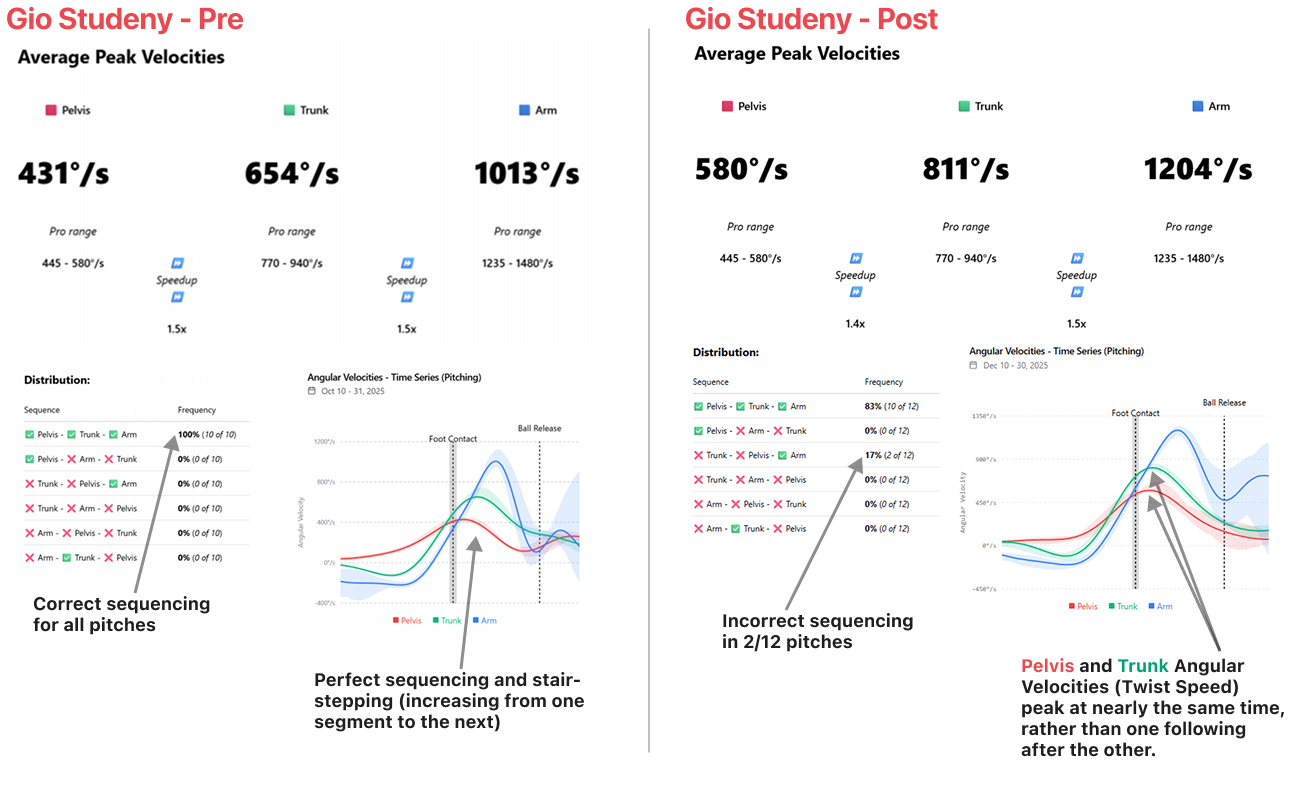
Gio Report Snapshots [Links to Full Reports: Pre & Post]
The outcome coaches care about
By the end of the 8-week block, Gio showed a major jump in how powerfully he was moving and how quickly he got the ball out.
Quicker delivery: time to release improved 1.17s → 1.10s
More explosive movement: pelvis and torso twist speeds jumped from 25th and 30th percentiles to the 70th and 80th percentiles!
Cleaner overall: after the program, he typically showed only one issue in his delivery mechanics compared to 3 flaws beforehand.
What likely drove the change
In practical terms, Gio improved two big foundations of velocity:
He stayed more stacked during the stride, which lets rotation happen faster and with less “bleed.”
He improved his front-side stability so energy could travel from the ground up instead of dying at landing.
What improved and why it matters
Closing the back (torso drifting/tilting during stride): 4/10 → 0/12 This is a big win because posture leaks are silent velocity killers. When the torso stays stacked over the hips, the athlete can rotate harder without compensating.
Knee collapse (front leg giving way): 6/10 → 3/12 A firmer front side gives the body something to rotate against. The cleaner this gets, the easier it is to build consistent velocity.
What to work on next
Elbow hike remained present in all pitches after the program. The simplest coaching intent for the next block is: keep the arm down longer so the body can lead and the arm can follow. That usually supports both performance and long-term arm/shoulder health.
Separating pelvis and trunk segments through the rotation. Gio sequenced incorrectly (trunk-pelvis-arm) in 2/12 pitches post program and exhibited a reduced max x factor pre to post. Creating separation through the core in terms of both timing and rotation should improve sequencing order as well as energy transfer up the chain.
“Using Uplift Labs was an absolute game changer for me as an athlete. It brought [to] light, my strengths, moreover my weaknesses. It shows athletes what key areas of the body they need to work on to take their performance to the next level.” - Gio Studeny
Athlete 2: Ashton Bricker (RHP)
Ashton was already a fast mover before the pitching program, but at times he exhibited various mechanical flaws. For athletes like this, progress is less about fixing obvious issues and more about refining timing and positioning so velocity increases without the athlete feeling like they have to throw harder with the arm.
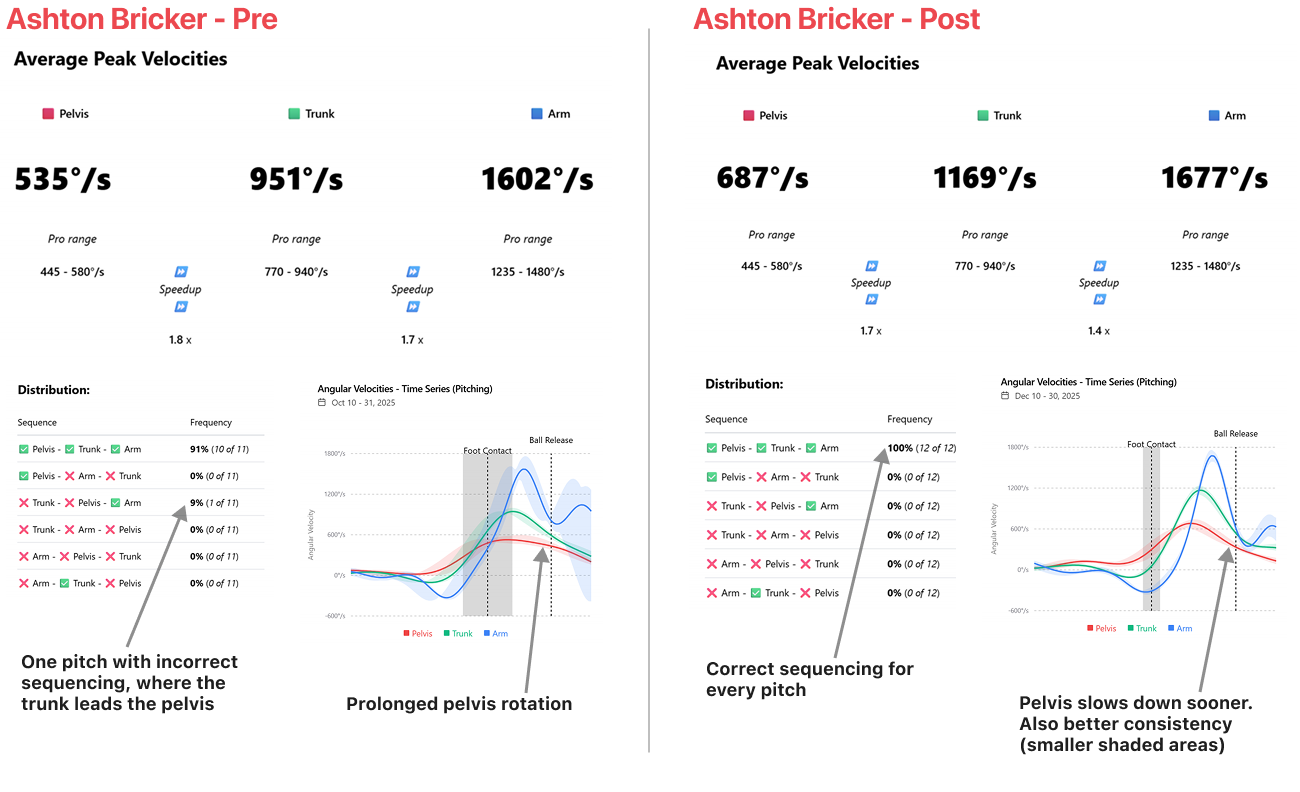
Ashton Report Snapshots [Links to Full Reports: Pre & Post]
The outcome coaches care about
Ashton added meaningful velocity in the same 8-week window.
Velocity up:81.8 → 84.8 mph
Movement efficiency up: finished in a top-tier range for hip and torso speed
Common mechanical flaws cleaned up: several issues went to zero after the program
What likely drove the change
The biggest visible story here was improved control of rotation and better timing of the arm.
When athletes stop flying open and stop lifting the arm early (elbow hike), the body can deliver rotational energy from the body to the ball more efficiently. That usually means the ball comes out faster with less effort.
What improved and why it matters
Flying open:2/11 → 0/12 Staying closed longer helps the athlete hold direction and deliver energy through the core.
Elbow hike:8/11 → 0/12 This is a major improvement. It often supports later, cleaner arm action and can reduce the “arm-dominant” feel.
High hand:3/11 → 0/12 Creating more forearm layback just prior to acceleration phase is another sign that the arm is syncing better with the body.
Closing the back:1/11 → 0/12 Cleaner posture through the stride is almost always correlated with better repeatability.
What to work on next
Late rise showed up more often post-program. This is not automatically “bad,” but it is a clear next-step coaching lever: get the forearm into a safer position sooner at foot strike while keeping the sequencing gains.
“Uplift helped me create better separation in my delivery. This not only helped me throw harder, but it also nearly eliminated arm pain. Throwing became easier both physically and mentally, and it allowed me to focus more on using my legs rather than trying to generate power solely with my arm.” - Ashton Bricker
The Takeaway for Academy Owners
The before-and-after process is valuable in a facility because:
It shortens the time from “something looks off” to a confident plan.
It gives athletes a simple scorecard they can understand.
It gives parents proof that training is not guesswork.
It helps coaches chase velocity while keeping arm health in mind.
A Simple Offer Academies Can Run
Package this as a repeatable service:
Baseline analysis + 8-week re-test for every pitcher.
Athlete receives:
Before/after videos
A one-page progress summary
1 to 2 priority coaching targets for the next block
Want to run this exact before-and-after process in your academy?