

This week, Uplift has released major improvements to Uplift Capture, extending our support for single-camera 3D motion capture and auto-capture, both of which we first introduced earlier this summer.
The full list of this week's improvements:
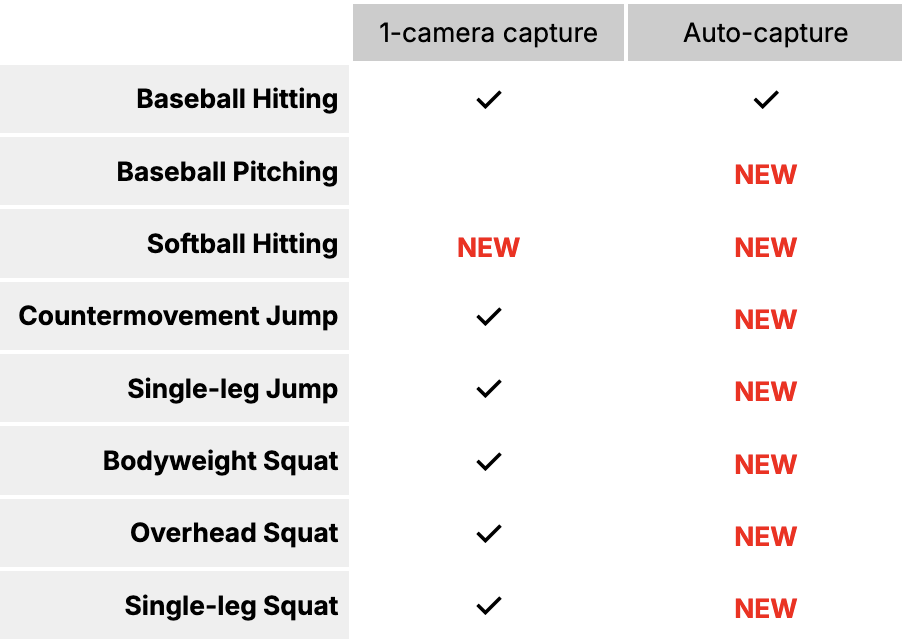
We've been investing a ton of time and energy in both of these product areas over the past few months, and I wanted to take some time to share why, and why now.
One of Uplift's goals has always been to bring reliable motion capture and movement analysis to places it's never been possible before. That's why portable, flexible setups have been baked into our DNA from day one. Reliability and accuracy have also been one of our core principles, and it's the reason we've focused so heavily on our two-camera solution. Having a full 3D picture of an athlete's movement leads to much more complete analysis and much more impactful insights. This has been especially true in the sports we cut our teeth on early on: baseball, softball, and golf, where the highly rotational nature of the movements meant multiple camera angles were a necessity.
It's also been our goal to make movement analysis - and the impact it can have on movement health and athletic performance - more accessible to more teams, coaches, and athletes. That’s been our primary motivator for developing single camera capture. Setting up one camera angle, without having to pair or sync devices, makes setting up and using Uplift Capture much easier and much more frictionless. Making full 3D movement analysis possible with a single camera means that assessing swing mechanics or jump landings, once done monthly or quarterly, can now happen at every training session or practice.
But why now? While one-camera movement analysis solutions have existed for some time, we believed in the value of full 3D analysis, which is why we've spent so much time making sure our one-camera solution can reliably analyze movement in three dimensions. And now that we’ve gotten there, we’ve wasted no time in expanding from the first expression of one-camera capture (earlier this summer with baseball hitting), to now supporting even more sports and functional movements with a single device.
Auto-capture is another feature I’m personally very excited about, because of how large a positive impact it has on the process of running an assessment. Auto-capture removes the need to manually stop and start recordings - it automatically detects when the athlete performs a movement, clips the video, and cues it to be uploaded and processed.
That means once a coach sets up their device, they can focus on what they do best: working with the athlete and bringing out their best, instead of babysitting technology. Because while tech adoption in sports is exploding, when it takes attention away from working directly with athletes, it becomes less valuable to integrate into a coach’s day-to-day workflow. Auto-capture eliminates a lot of that friction, and we're excited to see how many more assessments, and how many more performance-impacting insights, we can surface to coaches and athletes by reducing this barrier to use.
We've only just begun improving the accessibility and usability of Uplift Capture. Over the next few months, we'll continue expanding one-camera support and adding more movements that use auto-capture, testing and validating the reliability of our data and insights along the way. We're dedicated to enabling more coaches and athletes than ever to access 3D movement analysis to improve their movement health and performance.