
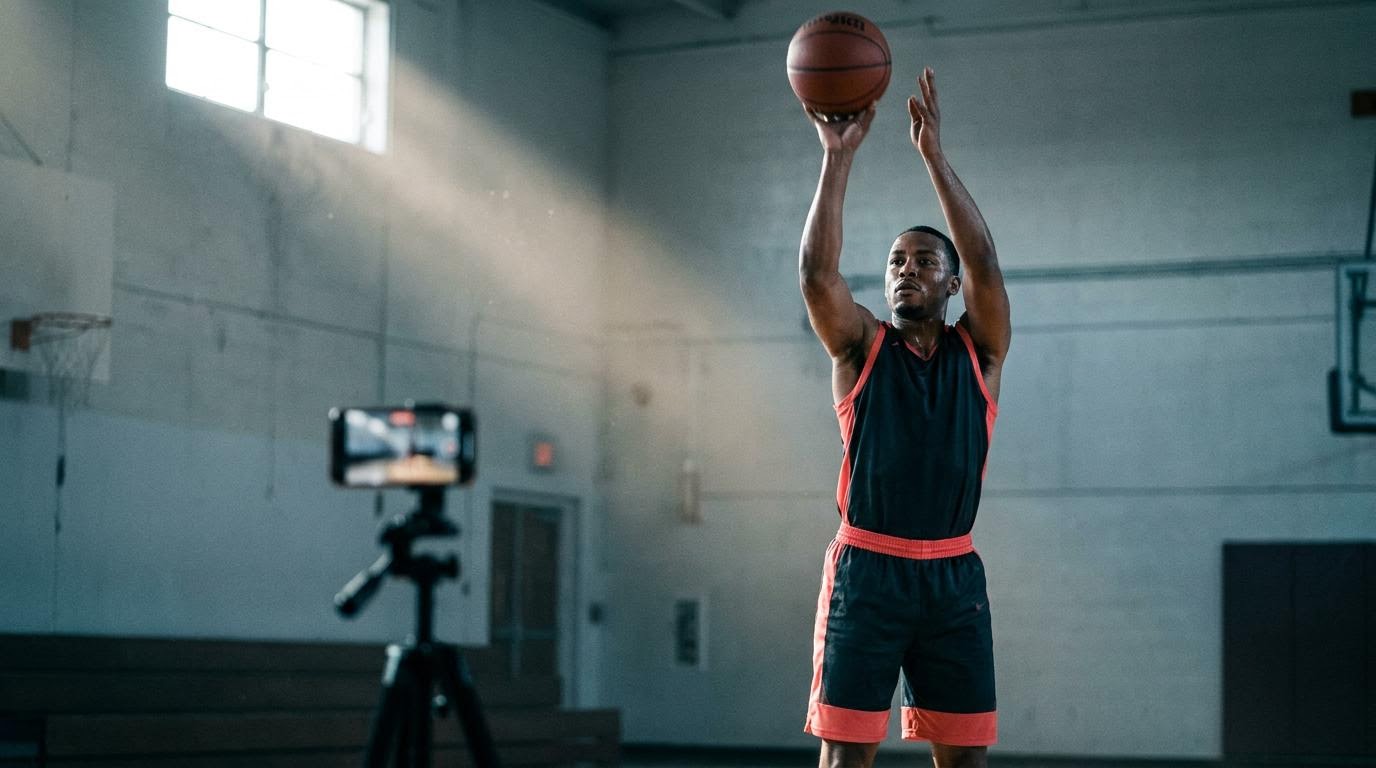
Basketball
Great shooters repeat their mechanics under fatigue; durable athletes land the same way every time. Uplift captures the jump shot, the vertical and the landing in true 3D, so player-development and performance staff can build both. Two cameras, in the gym.
Book a DemoFor player development & performance staff
Put two cameras on the baseline or wing and run your session. Uplift reconstructs the athlete in 3D on every rep, with no markers, no force plate and no lab, so you can see how the shot, the jump and the landing hold up, rep after rep.
Markerless 3D from two cameras
Shooting, vertical jump and landing in one session
Review frame by frame, compare any two reps
What you’ll measure
Two of the most trusted tests in performance and sports medicine, turned into numbers, from two cameras.
Power
Countermovement and drop-jump height, flight time and Reactive Strength Index.
Risk
Left and right knee valgus at landing — a key non-contact knee-injury indicator.
Absorption
Landing Stiffness Index and hip-knee dominance through the eccentric landing phase.
Symmetry
Limb-symmetry on jump and landing to flag compensation and re-injury risk.
Shot
Release angle and point, plus knee and hip extension on the jump shot itself.
Detail
Joint angles, velocities and 3D keypoints for every rep.
Questions, answered
A repeatable release (release angle and point) and lower-body drive (knee and hip extension), with true joint angles and velocities so you can compare any two shots.
Yes. The countermovement and drop vertical jumps give you jump height, RSI, knee valgus on landing, landing stiffness, hip-knee dominance and limb symmetry, for athletic testing and non-contact knee-injury screening.
No. Uplift reconstructs the movement in 3D from two iPhones or iPads, with no markers, no force plate and no lab.
Video is one 2D angle. Uplift gives true 3D joint angles and velocities, so you measure how the shot and the landing hold up instead of eyeballing them.
Ready to connect?