
Physical Therapy & Sports Medicine
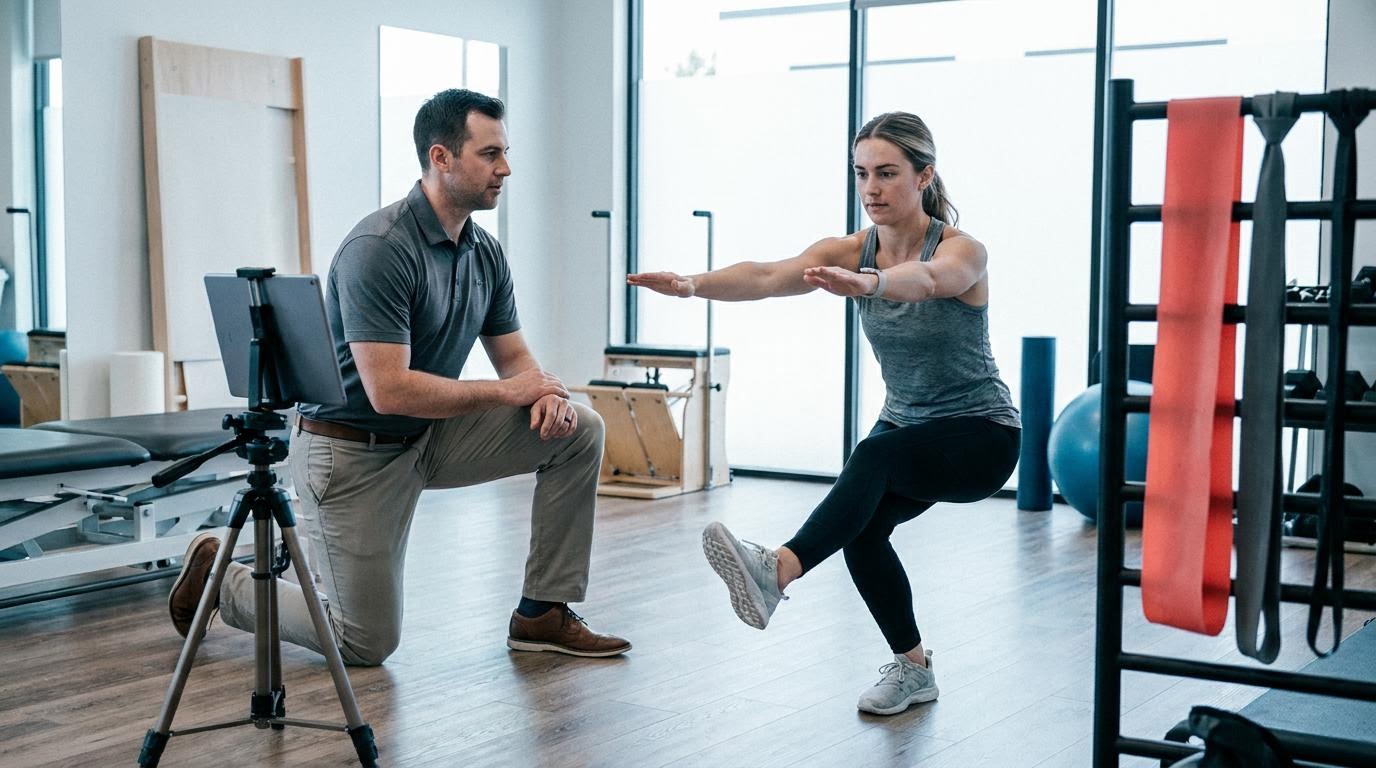
Goniometers and visual screens are subjective and hard to repeat. Uplift measures range of motion, squat and jump-landing mechanics, and gait in objective 3D, so your clinic can track progress, defend clearance decisions and stand out. Two cameras, no markers.
Book a DemoFor clinics & sports-medicine teams
So much of movement assessment still comes down to a clinician's eye and a hand-held goniometer: useful, but hard to reproduce between visits or between clinicians. Uplift captures the same assessments in objective 3D, so progress is measured, documented and comparable.
Range of motion, screens and gait in 3D
Repeatable measures every visit, with no inter-rater drift
Clinic or field-side: two cameras, no markers
What you’ll measure
From intake to clearance, the objective measures that replace the goniometer and the guess.
ROM
Ankle, cervical (flexion/extension & rotation), shoulder (incl. 90/90) and thoracic-spine mobility, in 3D.
Screens
Depth, knee valgus, trunk-tibia angle and hip-knee dominance, plus SFMA squat, toe-touch and back-bend screens.
Landing
Knee valgus on landing, Landing Stiffness Index, RSI, jump height and limb symmetry.
Balance
Postural control, dynamic reach (lower & upper quarter) and core stability.
Gait
Walking and running gait with a left-vs-right symmetry index.
Detail
Joint angles, velocities and 3D keypoints underpinning every assessment.
Return-to-play
Uplift gives you the data; the clearance decision stays with the clinician.
01
Pre-season or intake capture establishes the athlete's normal.
02
Re-measure ROM and gait symmetry to confirm progress between visits.
03
Limb symmetry, landing mechanics and ROM against your return thresholds.
04
Document the data behind the decision and keep monitoring.
Why clinicians choose it
Every capture produces objective 3D data that is consistent between visits and clinicians, with no inter-rater drift, and easy to share with the athlete, coach and surgeon. It builds buy-in, and it stands behind the clearance decision.
One workflow, two cameras, no markers. Uplift provides movement measurement and is not a diagnostic medical device; clinical decisions remain with the provider.
Questions, answered
Yes. Joint range of motion in 3D, including ankle, cervical spine, shoulder (with 90/90) and thoracic spine, without a hand-held goniometer.
It provides objective limb symmetry (jumps and squats), landing mechanics, range of motion and gait symmetry to weigh against your return-to-sport criteria. Uplift supplies the data; the clinician makes the call.
No. Uplift provides objective movement measurement to support clinical judgment; interpretation and decisions remain with the qualified provider.
Bodyweight, single-leg, overhead and SFMA squats; drop vertical and countermovement jumps; single-leg stance, Y-Balance and plank; SFMA toe-touch and back-bend; and clinical gait, all in 3D from two cameras.
Ready to connect?