
Tennis
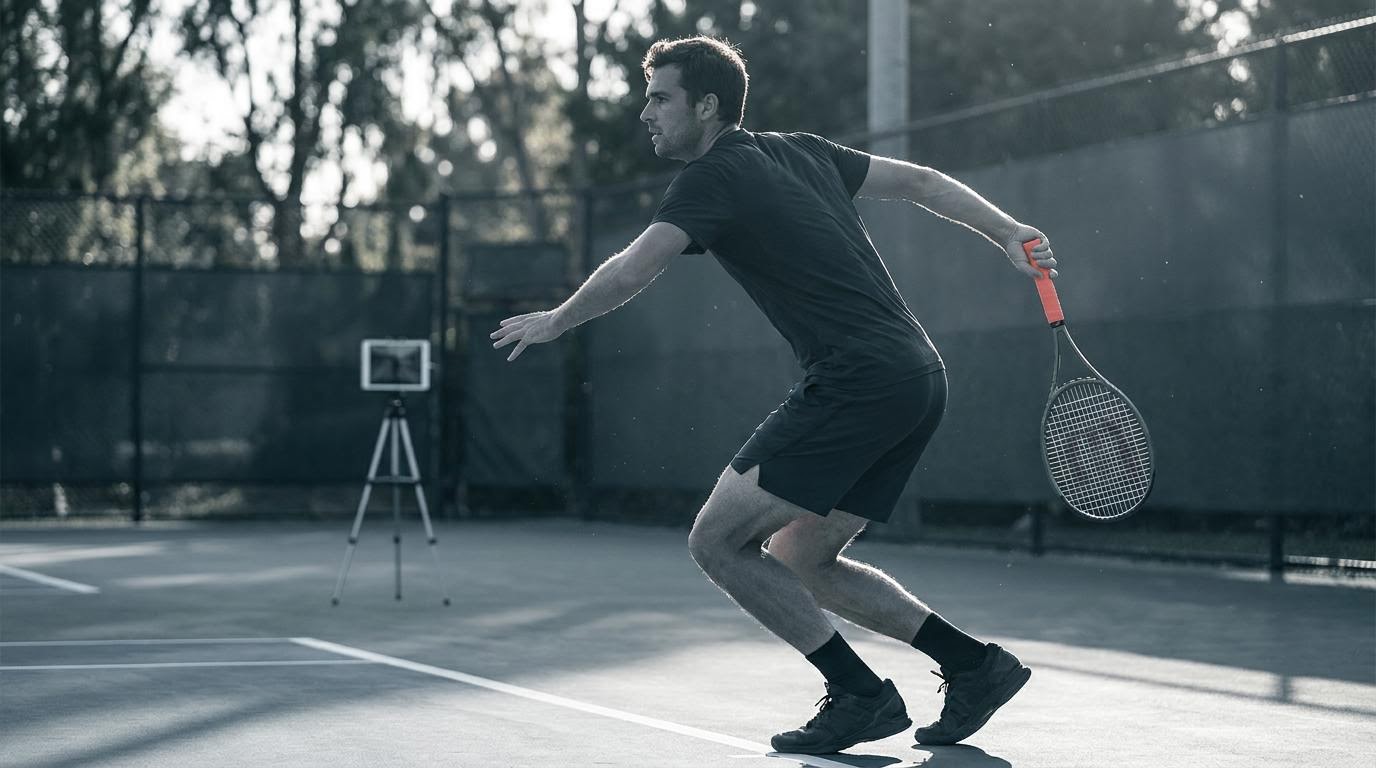
Racket-head speed is built from the ground up: legs to hips to torso to arm. Uplift captures that sequence in true 3D so coaches and academies can add pace and protect the shoulder. Courtside, from two iPhones.
Book a DemoFor coaches & academies
Two cameras, courtside, capture the point, and Uplift reconstructs the player in full 3D: torso, both arms, pelvis and legs. No wearables, no calibration ritual, no lab time. Just the mechanics behind the serve and every groundstroke.
Serve, forehand and backhand in 3D
Per-segment speed for torso, upper arm and forearm
Captured at up to 240 Hz, courtside
Inside the serve
Uplift breaks the serve into its phases so you can see exactly where speed is lost, or where the shoulder is taking on load it shouldn’t.
01
Ball release, loading and cocking, as the knees bend and the shoulder loads into external rotation.
02
Peak external rotation in the cocking phase: the loaded ‘bow’ before the strike.
03
Explosive internal rotation to contact, driven by the torso → upper arm → forearm sequence.
04
Deceleration to the finish, and how safely the arm sheds load.
What you’ll measure
The measures that build racket-head speed, and the ones that flag arm overload.
Shoulder
Peak shoulder ER in the cocking phase, central to both racket speed and arm load.
Sequencing
The forward sequence (torso → upper arm → forearm) and the twist sequence.
Power source
Knee flexion and extension velocity through loading and acceleration.
Speed
Peak torso, upper-arm and forearm angular velocities into contact.
Groundstrokes
Forehand trunk rotation and racket-arm position; backhand cross-body and shoulder internal rotation.
Detail
Shoulder, elbow, knee and wrist angles and velocities, plus 3D keypoints.
By the numbers
3D
True joint angles, not one 2D view
240 Hz
Capture rate
2
Cameras (iPhones or iPads), no markers
Questions, answered
The serve, forehand and backhand, each with true joint angles, segment velocities and, on the serve, the full kinematic sequence.
Yes. Torso → upper arm → forearm, with the peak velocity and timing of each link, so you can see where the chain breaks down.
Uplift measures peak shoulder external rotation and the follow-through deceleration, the mechanics tied to arm load, so you can monitor them over a season. It’s measurement, not diagnosis.
No. Capture is markerless from two cameras, so a player just plays while you record.
Ready to connect?